

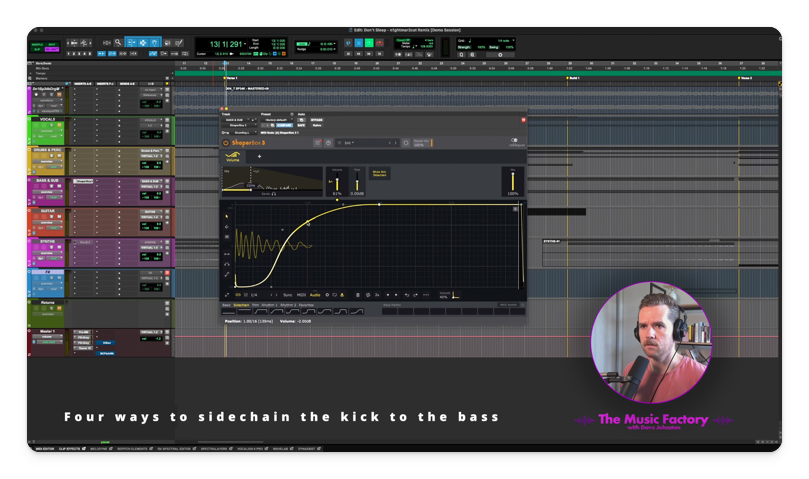
The kick drum and bassline pose mixing challenges because their core frequencies overlap in the low end of the spectrum. Deciding which one should be more dominant - often depending on the style and genre - and giving it a slight volume edge over the other is a good starting point for getting the balance right. From there, several mixing techniques can help the kick and bass sit together more effectively. Some of these involve sidechain processing.
Sidechaining a kick drum to an appropriate processor on the bass track can temporarily reduce the bassline’s energy, creating space for the kick to punch through clearly (often called ‘ducking’). When done well, neither track will suffer much, but both will sound clearer in the mix. Giving each track its own space prevents overlapping frequencies from building up into undefined, low-end muddiness.
Isn’t Sidechain Ducking Just for EDM?
While it’s often used to create the familiar rhythmic pumping effect heard in EDM and other electronic genres, it can also be applied effectively to pop, rock, and other genres. As well as making the kick and bass more audible, a bit of sidechain processing can give the low end that ‘glue’ feeling where the tracks seem more connected, as if they’re grooving along together as one.
Sidechain compression techniques originally arose to solve problems, used by engineers to create early de-essers and to automatically duck music beneath a radio DJ’s voice in broadcasting (where the ‘ducking’ term came from). It became common for some studio engineers to use the technique subtly to help kick drums cut through dense basslines in the ‘80s, but it wasn’t until the ‘90s that dance music producers began using it in a more overt, intentional way as an effect. Since then, it’s become a staple sound in electronic genres.
As with many mixing challenges, using several approaches together is often the best way to achieve a great result. I think about the relationship between kick and bass when applying EQ, compression, and sometimes saturation, and I generally shape the kick drum’s envelope based on its role in the arrangement (I’ll dive into these topics in future articles). All of these, along with sidechain processing, can work together to improve the relationship between kick and bass across a wide range of genres.
Let’s take a look at four different sidechain approaches for kick and bass, each giving a slightly different result. I’ve also included a video demonstration of these four approaches below.
1. Using a Compressor’s External Sidechain (Classic Approach)
This is the conventional way to achieve the widely recognised ducking effect. The bass compressor’s external sidechain receives input from the kick drum, and each time the kick hits, it triggers the compressor to quickly duck the volume.
You’ll need to play around with the attack and release settings to get it sitting right. Generally, a fast attack is required because you’re dealing with transients; otherwise, the front of the kick drum will get through before the bass ducks down, so the compressor won’t be doing what you want. Make sure you check how fast your compressor can react without causing an audible click - not all compressors do a great job with attack set all the way up. Adjust the release so that it fits well with the groove of the track.
Some modern digital compressor plugins also have ‘lookahead’ settings. This will introduce a small amount of latency in exchange for letting the compressor see what’s coming up, allowing the compressor to reach the target gain reduction at the precise start of a transient, eliminating the clicks or pops that often occur with near-instantaneous attack settings. This is particularly handy when sidechaining a bass with a kick, because lookahead means the bass is already out of the way when the kick hits, creating an even cleaner separation.
2. Using a Volume Shaper with an Audio Trigger (More Control)
LFO tools let you shape parameters like volume over time, synced to your DAW’s tempo, frequency in hertz, or triggered by MIDI. These tools have been around for a while, but some of the newer ones - such as Shaperbox 3 - can be triggered by audio events, including an external sidechain signal. This means you can set up a shaper module in the same way as you would with a sidechain compressor. The advantage of a shaper module is that instead of attack, release, and threshold, you can draw in the precise shape of the ducking. With Shaperbox, you can even make it reactive to the input level, so it uses your ducking shape while also adjusting the amount of ducking based on the input signal level; heavy kicks duck the bass more, while lighter kicks duck it less.
While Shaperbox doesn’t have a lookahead option (hopefully a future version will introduce this feature), you can get a similar result by starting the volume level from closer to the low point rather than at 100%, so that when the kick hits, the shape is essentially increasing back to full volume rather than having to quickly duck right down first.
3. Only Ducking the Low End - Multiband (Subtle)
This technique can be done either with a plugin like Shaperbox 3, or with a multiband compressor such as Fabfilter Pro-MB. The setup is the same as the two previous techniques, except that you only duck the low end of the bass using multiband functionality. If you set the crossover just above where the punch typically occurs in the kick drum (around 100Hz), you duck out the most problematic clashing frequencies from the bass while leaving all the mid- and upper-frequency detail at full volume. Like Fabfilter’s compressor Pro-C 3, their bultiband Pro-MB has lookahead, which I’d recommend using for sidechaining.
4. Only Ducking the Low End - Spectral Dynamics (Subtle)
Using the sidechain feature of a plugin such as Soothe2 provides a particularly transparent way to duck the low end of the bass when the kick hits. With the multiband approach discussed in the previous point, you achieve greater transparency than a single-band compressor by ducking only the low end of the bass. The difference with using a spectral dynamics plugin like Soothe2 is that the frequencies being ducked match the specific kick drum you’re using, offering an even more transparent option. Soothe isn’t just being triggered by the level of the sidechain signal; it’s reacting to the specific high-energy frequencies in your kick drum and ducking only those frequencies from the bassline, connecting the two more like puzzle pieces.
While Soothe is a popular choice for this technique, including by star mixing engineers like Jaycen Joshua, one thing to note is that Soothe2 doesn’t have a lookahead function. There are some other spectral dynamics plugins that do have lookahead, such as threebodytech SpecCraft. While SpecCraft might be a bit more fidgety to set up than Soothe, the addition of lookahead is a particular strength for creating transparent sidechaining.
Choosing the Right Tool for Your Track
Approaching the relationship between kick and bass involves selecting the right tool for the specific musical context. Whether you opt for the rhythmic energy of a classic compressor, the subtlety of a multiband approach, or the surgical transparency of spectral dynamics, these sidechaining techniques are useful additions to your toolkit for maintaining a solid low end. As you experiment with these workflows, remember that the goal is to create a cohesive foundation in which both elements can coexist without much compromise. By effectively combining these sidechain approaches with other mixing techniques, your rhythm section will have both the weight and the clarity to carry the rest of your mix.
💬 Have you experimented with the newer spectral dynamics methods for sidechaining, or do you still find the tactile control of a classic compressor or volume shaper more intuitive for your productions?
ICYMI: My Latest Release
Copycat EP 01 is a collection of covers dedicated to artists who have influenced my musical identity. It was a gratifying creative challenge to transform the songs into something new with the sonic fingerprint of n1ghtmar3cat while retaining what made them special to me in the first place.


One of my favorite production/mixing techniques is kindof a mix of volume automation and sidechain compression. I'll use the envelope follower to automate the attack on any bass that hits at the same time as the kick drum. dont ask me why lol
I'm looking forward to reading this later