

I’ve been enjoying Waves Audio’s new “Mix Trick or Trash?” video series, which features hot-take interviews with studio legends who are asked to rate widely circulated “mixing tips” on a 10-point scale. They’re entertaining to watch, but they also highlight a surprising divide. When asked to rate the statement: “Always mix with reference tracks”, industry giants are often dismissive.
Joe Chiccarelli gives it a zero: “I hate reference tracks… I want to make the record that sounds right for that artist”. Chris Lord-Alge agrees, calling it “Pointless”, while Chris Galland warns that if you “chase the sound of another recording, you’re going off”.
These are some pretty strong opinions from pros with incredible track records, and they contradict my own practice. Surely you can make a unique-sounding record while also finding it helpful to check how your mix sounds alongside pro releases?
The Problem with Blanket Advice
I’ve been thinking about why this advice differs so much from my own opinion, particularly as I often recommend that beginner engineers use reference tracks to improve their critical listening skills and level up their mixing. If you’re putting your mixes up against the work of the best engineers in the world, the comparison can be humbling, but it gives you something to shoot for. It can make you ask yourself difficult questions, such as: “What are they doing that I’m not?”, or “How are they getting it to sound so big?”, or “Why can I hear all the instruments in their mix so clearly, but the sounds are a bit murky in my own mix?” These are useful realisations to have when you’re developing your skillset, and they can send you down useful learning rabbit holes.
While pro mixing engineers who have been at it for decades may have significantly reduced their need to ask these questions, there are many reasons someone might use reference tracks, and different situations in which they might be used. This makes questions like “Should you use reference tracks? - Y/N” unhelpfully vague.
Why Some Engineers Don’t Use Reference Tracks
Pro Studios and Consistent Listening Environments
Ultimately, I suspect the most likely reason these mixing engineers don’t use - or recommend using - reference tracks is because they are working in world-class studio environments every day. They have become intimately familiar with their rooms and their highly consistent setups designed and treated specifically for critical music listening, so their mixes can be trusted to translate very well.
In such situations, reference tracks may genuinely not be needed as much. The engineer can be highly confident that what they think they’re hearing is, in fact, what they’re hearing. The problem is that many engineers - myself included - aren’t consistently working in the same space, or in highly optimised studio environments.
Creative Identity
Some engineers talk about not wanting to sound like other artists, emphasising that every track should sound unique. They trust their internal compass to guide the creative direction of the mix rather than relying on external influences. This is a fair approach, but I suspect that most of the engineers who give this advice work in the same pro studio environment consistently, taking us back to point one above, so some of the reasons for using reference tracks are significantly nullified anyway.
Vast Experience
Over time, mixing skills and instincts are honed, and the need to benchmark gradually diminishes. However, I still think this ties back, at least in part, to the first point about the consistent listening environment in a pro studio. These engineers will likely have worked in a familiar space for a long time and built up a decent collection of gear. Even if they needed to relocate their studio, they’d have the knowledge and means to get back up and running quickly. But still - if a vastly experienced engineer needed to mix in an unfamiliar studio with speakers they weren’t used to, I suspect that listening to some familiar tracks would help calibrate their judgement.
Ultimately, while some top-shelf mixing engineers may choose not to use reference tracks in their workflow, I think there are many benefits to learning to use them properly, and it’s unhelpful to advise new engineers against using reference tracks as a tool.
Why I Use Reference Tracks
1. Early discussions with an artist
If an artist invites me to work with them as a producer or mixing engineer to help bring their project to life, the first thing I’ll do is meet up in person for coffee to chat about their project, what they want to achieve, and why they want to work with me in particular.
Once we’ve kicked off the chat, I’ll often ask them to share some reference tracks to give me an idea of the broader sonic world they’re aiming for. I’ll usually ask for something that broadly captures the vibe they’d like, and sometimes ask for references that are more targeted to how particular instruments sound.
The point of these requests isn’t to copy the tracks they provide, but rather to help me build a sonic picture of what they might want. It can be hard to get your vision across purely through verbal or written language; music can convey so many things about emotion and energy that just aren’t easy to put into words, which is why I find reference tracks useful here.
2. Calibrating my ears before mixing
When I’m about to get stuck into a mix, I sometimes play familiar tracks while I’m getting set up. This is partly to get me in the mindset for mixing, but more importantly, it helps to calibrate my ears and prepare my broader judgment for the work ahead.
I won’t necessarily listen to tracks suggested by the artist whose work I’m going to mix, or even strictly play tracks in the same genre. I’m also not loading reference tracks into an analyser or sitting in the optimal listening position the whole time in this situation - I’m probably wandering around making a coffee! At this point, it’s more about getting in the mood, with the added bonus of calibrating my ears.
3. Mixing in different spaces and using headphones
I’ve done mixing work in many different places over the last ten years; I certainly haven’t worked regularly in a pro studio with great acoustics I can get used to. I’ve moved house several times, so my home studio setup has varied. None of my home studios has been an ideal listening environment; when you know you’re not going to be living somewhere long term, or the room is a multi-purpose space, it’s difficult to set up a space that sounds great for mixing. As such, I’ve grown very used to checking mixes on headphones. On top of this, I often work remotely on my laptop in locations with no monitors at all, where headphones are the only option. Because I often listen in different environments, reference tracks serve as a vital, consistent benchmark.
4. Checking tonal balance late in the mix
It’s amazing how our perception of tonal balance can drift off course during a long mixing session. Generally, the relative balance between tracks within a mix isn’t significantly affected by this drift, because we’re making decisions based on how those tracks relate to one another. As such, it’s not a major issue once you’re aware this can happen, as there are some easy fixes.
Alongside taking regular breaks, I find it very useful to check my work against reference tracks once the mix is taking shape. A quick check of some reference tracks can help me identify small EQ or balance nudges I need to make on individual tracks or on the master bus to bring the whole picture back into focus.
When using reference tracks for this purpose, I'm being more critical, but I’m still trying to get a broader sense of where I’m at; I’m not trying to copy another track. I’ll generally load up several reference tracks - at least one will be in a similar style, but sometimes I also listen to tracks that I think sound great from bordering genres, depending on what I’m listening for.
There are a couple of important considerations to make when using reference tracks for critical listening:
Instant A/B Switching: You need to be able to instantly switch between the reference track and your own mix. Even a brief silence between the tracks can be enough for your ears to adjust slightly, preventing you from making an accurate comparison. A system that allows for an instant switch will make your comparative judgments more accurate.
Level Matching: You need to adjust the reference's loudness so you’re listening at a level similar to your own mix. This avoids “loudness bias” - the perception that the louder track sounds better simply because it’s louder. Our ears get easily tricked by small differences in volume.
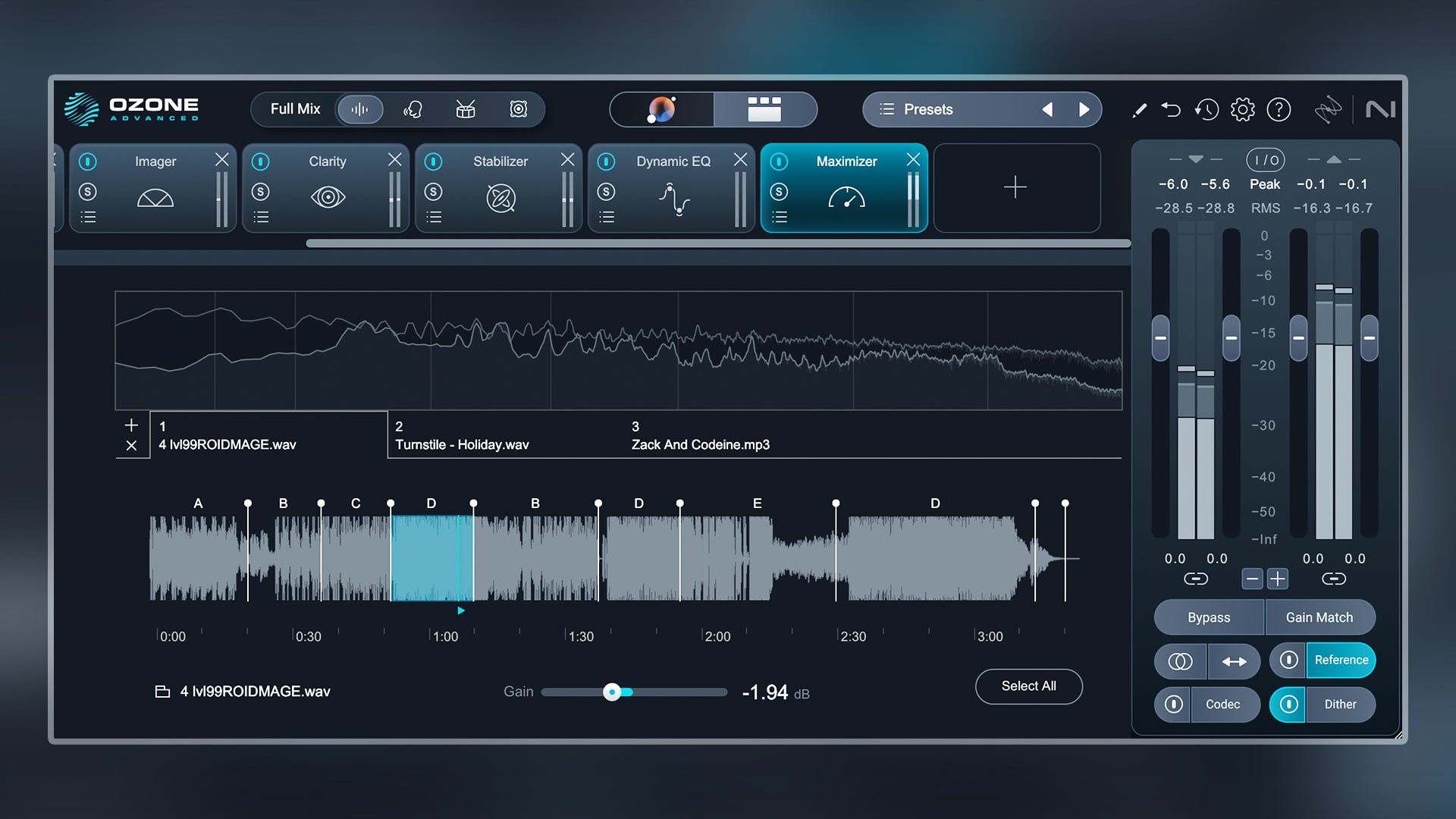
Fortunately, there are several great referencing plugins out there. I usually use iZotope Ozone 12 for convenience, since it has a built-in referencing system and I always have Ozone on my master bus. Some may prefer tools like Reference 3 by Mastering The Mix, which offers a much deeper set of analytical tools specifically for referencing.
What I DON’T Use Reference Tracks For
To be fair, even though Chris Galland rated the idea of using reference tracks a one out of 10, I agree with the core of his follow-up warning: “If you chase the sound of another recording, you’re going off”.
There’s a psychological risk in “chasing”. When you become too fixated on mimicking the frequency spectrum of a popular commercial release, you risk shifting too far into the technical mindset, which can kill your creative flow. Instead of following your instincts with your own mix, you end up stuck on minor discrepancies between your work and the reference, quickly leading to decision fatigue and ear exhaustion.
My goal isn’t to emulate a specific artist or engineer’s sound. I use reference tracks as a sanity check to ensure my mix is in the ballpark of professional standards, but I don’t want that process to dictate the track’s artistic identity. This is also why I avoid “match EQ” tools; I don’t want to paste someone else’s specific mix frequency profile onto my own work.
Personal Preference
Fortunately, a couple of the other engineers in the Waves Audio series came to the rescue for reference tracks, noting that they’re helpful in certain situations. Noah “MIXGIANT” Glassman (Doja Cat, Burna Boy, Pink Pantheress) mentioned that “if an artist has a specific vision, then it’s nice to use that as a reference point for balance or space or vibe, but I think every song is different. So there’s never going to be a one-size-fits-all situation”. Grammy-winning producer Oak Felder (Lizzo, Demi Lovato) said that referencing “can be useful, especially when the artist is looking for something specific”. Outside the Waves series engineers, there are many other advocates reference tracks. Writing for iZotope, Nick Messitte writes about how it can “drastically improve the consistency and quality of your work“ in this article. Scottish audio engineer Michael Wynne, behind the fantastic YouTube channel In The Mix, has a helpful video about reference tracks here.
At the end of the day, a reference track is just that: it provides a reference point. We refer to many things in everyday life to guide us. The wider nature of culture involves borrowing existing ideas and adding flair to create new things. It’s extremely rare that anything is made without any points of reference at all, and it’s healthy to acknowledge this; we’re all referencing in some way or another when we create. Referencing music can guide your perspective when your ears get tired, when your room acoustics are playing tricks on you, or when you’re trying to gauge the vibe a client is looking for. There’s so much to learn by benchmarking your work against that of the world’s best mixers.
By understanding why you are using a reference track - whether it’s for ear calibration, client communication, or a late-stage reality check - you can make sure your mixes translate well, no matter where they are played.
ICYMI: My Latest Release
Copycat EP 01 is a collection of covers dedicated to artists who have influenced my musical identity. It was a gratifying creative challenge to transform the songs into something new with the sonic fingerprint of n1ghtmar3cat while retaining what made them special to me in the first place.


The more I explore reference tracks, the more I want to gather specific examples of sound rather than styles. A really thick but tight acoustic bass. A controlled sibilant male voice. Wide acoustic strings. Non abrasive trashy guitars. I’m still trying to find the right examples, but I’m leaning towards targets for problem areas rather than polished mixes.
Ps… is there something about how you’ve done your substack site that works differently between the Substack app and the web? I could post a comment here on the app as above, but when logged into Substack on the web, when I pressed “comment” it took me to your actual web site where I would have needed to create a profile if I was to comment. Is that what you intend?