

The Perfection Trap
It’s easy to get bogged down in the pursuit of perfection when creating music. At some point in our careers, many of us have spent hours, days, or even weeks stuck on choosing the “right” synth patch or agonising over a single lyric in a bridge too early in the process, searching for a result that remains just out of reach.
As I built up more experience in songwriting and production - and worked with a growing number of talented people - I started noticing a pattern. I eventually realised something that fundamentally changed my mindset and helped me build more productive creative habits:
The most effective way to approach creative perfection is to acknowledge that it simply does not exist.
Instead of chasing an impossible standard from the get-go, there’s a more productive - and ultimately more enjoyable - way to approach the creative process. It just requires a small mindset shift, and I find a particular analogy helpful for explaining it.
The Sandpaper Analogy
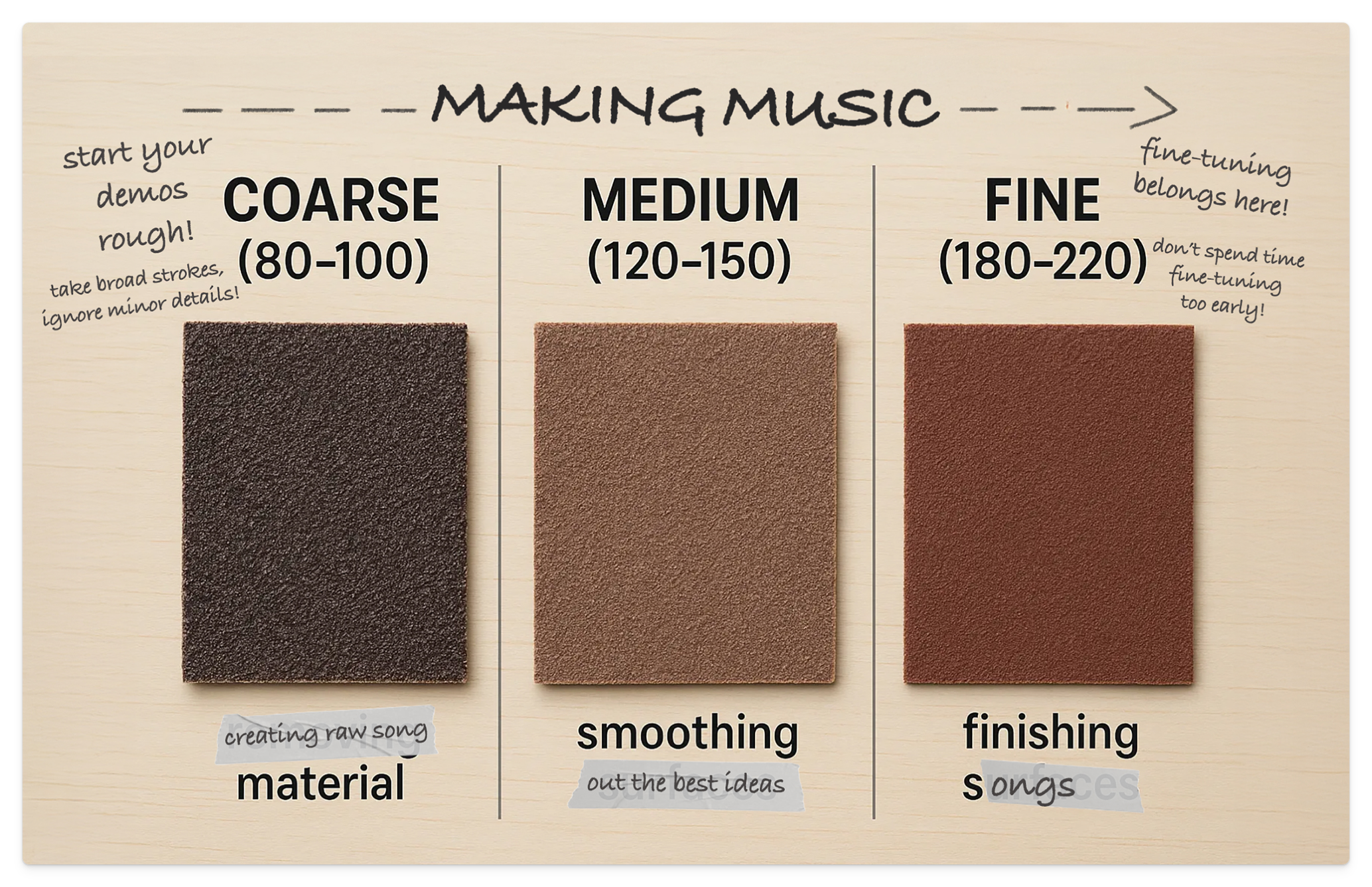
This productivity analogy was introduced to me by producer and Shihad drummer Tom Larkin. The core idea is that in the early stages of the creative process, you should aim for broad strokes and rapid progress while intentionally avoiding minute details. This allows you to generate more demos in less time.
Think about it in terms of woodworking: when sanding a piece of wood, you wouldn’t begin with fine-grit sandpaper. Progress would be incredibly slow, and the paper would wear out before you made much progress. It’s far more efficient to start with a coarse grit to remove the bulk of the material and shape the wood quickly, then move to finer grits for refinement later.
Prioritising Efficiency in the “Generation” Phase
In my workflow, I divide production into three stages: Generation, Development, and Refinement (I’ll dive deeper into this model in a future article).
The coarse sandpaper approach belongs to the Generation stage. This is the time to be messy. Instead of getting hung up on EQ-ing a kick drum or perfecting a vocal melody that might not even make the final cut, your only goal is to capture the essence of an idea and move on to the next one.
If you labour over one demo for an entire month, you end up with exactly one demo. It might be good, but it might not. However, if you spend that same month making fifteen rough-around-the-edges demos, you can then pick the top three to move into the Development stage. Statistically speaking, picking the best three out of fifteen options gives you much better odds of success than having only one option to work with.
Practical Exercise: “30-Minute Mining”
This is an exercise I use to build a collection of new song ideas for my solo project, n1ghtmar3cat. Thanks to producer Alex Wildwood for sharing his version of this concept at a workshop a few years back.
The ‘30-Minute Mining’ exercise is simple: Set a timer for 30 minutes and challenge yourself to create a piece of music from scratch. To make this work, I use a custom-built DAW template with audio tracks and useful virtual instruments already set up - a piano, a versatile synth, bass sounds, a basic virtual drum kit, etc. - so I don’t waste time browsing plugins (I walk through my template in this article).
The beauty of the strict time constraint is that it forces you to:
Make quick decisions and trust your initial instincts.
Avoid overthinking and bypass “analysis paralysis”.
Focus on the core arrangement rather than getting lost in sound design or micro-edits.
Side note: If you’re interested in learning more about this exercise, I’ve created a 30-Minute Mining PDF guide, which is free for my Substack subscribers (a $47 value). Subscribing is free, and you get the added bonus of receiving these articles directly to your inbox once a fortnight.
The Benefits of Embracing Imperfection
This approach has been transformative for my workflow. By embracing imperfection early on, I’ve become more productive and less “precious” about individual ideas. If a 30-minute sketch doesn’t work, I haven’t lost a week of my life - I’ve only lost half an hour, and I know I’ll have another go the next day!
All the 30-minute sketches get filed and indexed in an “Ideas Bank” folder. They might not be right for today, but they often become useful later on to harvest ideas for other projects. It has freed me to experiment more and discover unexpected musical directions that I likely would have missed if I were hyper-focused on perfection from the start.
Key Takeaway
Don’t let the pursuit of perfection stifle your output. Embrace the coarse sandpaper approach. Get those ideas down, iterate quickly, and trust that you’ll have plenty of time to refine and polish them later. The most important thing is to keep the creative momentum moving and enjoy the experimentation.
💬 How do you handle the “blank canvas” when making music? Do you prefer to work slowly on one idea, or are you a fan of rapid-fire sketching? Let me know in the comments.
ICYMI: My Latest Release
Copycat EP 01 is a collection of covers dedicated to artists who have influenced my musical identity. It was a gratifying creative challenge to transform the songs into something new with the sonic fingerprint of n1ghtmar3cat while retaining what made them special to me in the first place.


This is great. Resist the urge to polish too early!
Great analogy. The longer I’ve made music the more I embrace the demo and early stage. Don’t rush to polish until the ingredients are there.
I also write about making music