

The “car test” is a time-honoured music production tradition: driving around the block, cranking up the sound system, and hearing how your latest mix stacks up outside the studio. It’s a chance to evaluate your work - or a collaborator’s - in a real-world setting.
It’s a polarising concept, though. Some producers and mixing engineers swear by the car test as an important part of their checking process, but others write it off entirely as an unreliable waste of time.
I’m going to put my hand up and say I’m firmly in the former camp. I’ve found the car test to be a genuinely useful part of my workflow for many years now. In this article, I’ll explain why I’m such a fan and why it could be worth considering for your own process. At the same time, I’ll outline a few important caveats to consider so you don’t ruin a good mix by making the wrong judgment calls.
An Acoustic Nightmare
If we look at a car purely through the lens of studio acoustics, it is objectively terrible:
Off-axis position: You don’t sit in a nice equilateral triangle between the left and right speakers. Because you’re sitting on one side of the vehicle, you get an asymmetrical stereo image, making it nearly impossible to make accurate panning decisions. Plus, there are usually more left and right speakers pushing out sound from the back seat area too.
Harsh early reflections: You’re also surrounded by untreated glass and hard surfaces. There’s a side window right up next to your head, creating immediate early reflections that interfere with what you hear directly from the speakers.
Frequency masking from road noise: Driving adds significant low and low-mid rumble. This ambient noise creates frequency masking, swallowing up subtle elements in your mix. Decorative production touches, subtle reverb tails, and background ear candy that sounds great in headphones can completely vanish.
Drastic sound variation based on your seat: If you’ve ever had a friend drive your car and you’ve sat in your own passenger seat, you might be shocked at just how different the listening experience can be compared to what you’re used to as the driver. Even worse, if you have a sub in the boot that’s nicely levelled for the driving position, by sitting in a back seat you’ll probably experience the lows at least twice as loud, almost like putting a giant low-shelf boost on your entire mix. Not ideal.
Ironically, these flaws can be part of what makes the car test so useful (except for the last one). They can really bring problems to the fore, highlighting issues that may be less obvious when listening in your studio environment, and this can force you to make decisions that benefit your mix. Is that subtle background element in the verse important enough to keep? If it is, you might need to adjust the EQ or volume so it cuts through better. If it’s not that important, it might just be cluttering the mix, and deleting it might be the right move. Can you hear the vocals properly even when the other elements aren’t nicely panned out of the way? If not, you’ve still got work to do.
Bass and low-mid balance issues can be particularly pronounced in the car too. If your lows aren’t well defined, they’ll get totally consumed by the rumbling road noise and the mix will sound tinny and thin; but if they’re too loud or not well controlled with appropriate compression and EQ, certain notes will jump out more than others, or the whole thing will just sound like mud.
Not Just Any Car Will Do
Despite all of these acoustic flaws, cars are one of the most common places for many of us to listen to music. But there’s an absolutely critical consideration to bear in mind if you’re making any changes to your mix based on the car test: it has to be your own car, or at least one you drive regularly.
Just like when using reference tracks, having a high level of familiarity is the main thing you’re leaning on here. The car test is only useful if it’s the vehicle you spend hours in every week listening to your favourite music, podcasts, audiobooks, or the radio. You always sit in the driver’s seat, so you know what music sounds like in that particular position. You know that specific stereo well, and ideally you have a custom EQ curve set up, which means you instinctively know what a balanced mix should feel like in that space.
If you jump into someone else’s car, you still face all the acoustic drawbacks, but without any of the anchoring benefits of familiarity. You won’t know the quirks or frequency spikes of their system, and sitting in a different seat will throw you off entirely. Making critical mix adjustments based on a casual listen in a friend’s car is more likely to ruin your mix than improve it!
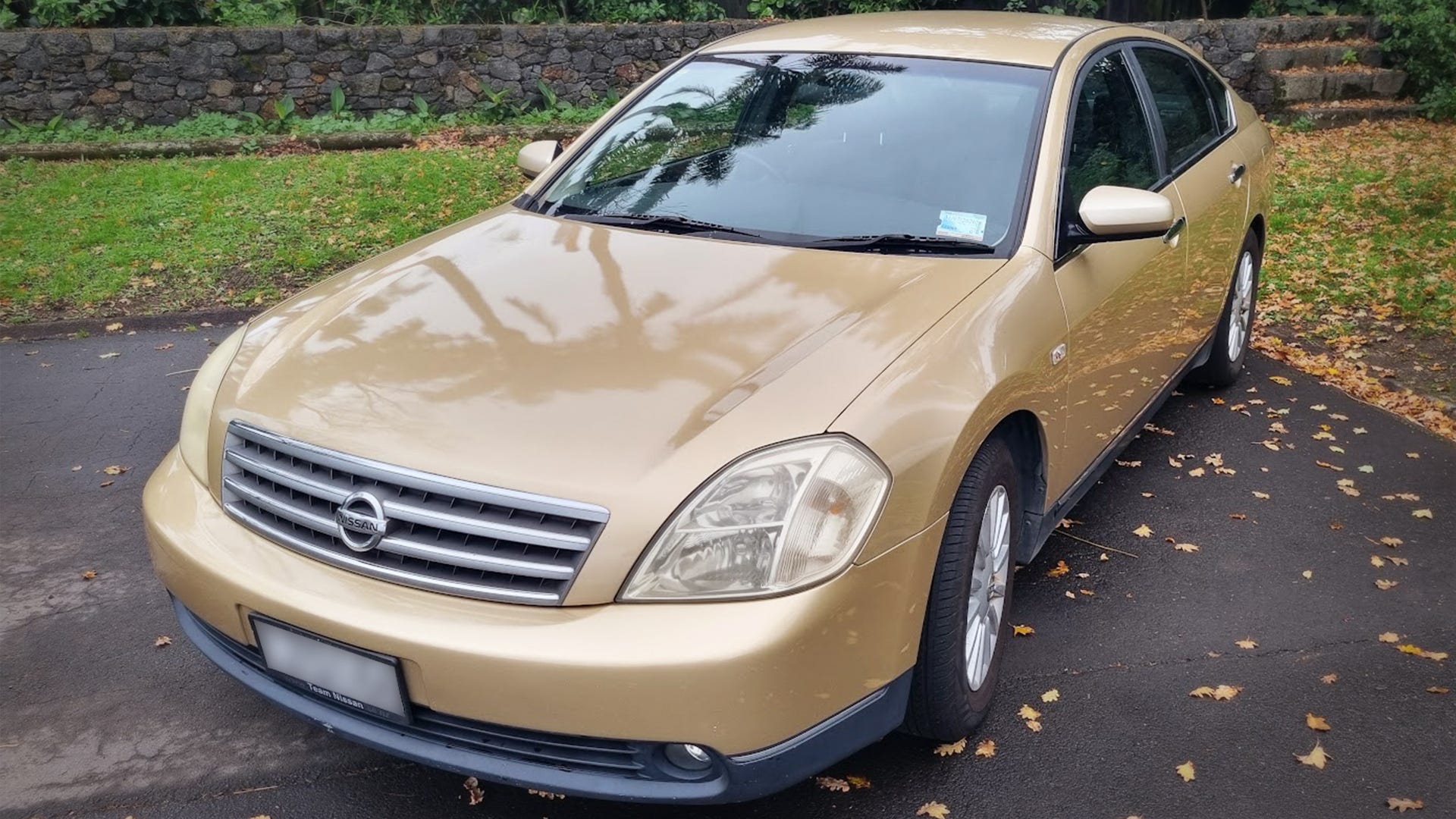
Lessons from my Beloved 2005 Nissan Maxima
I spent so much time on long drives in my gold coloured 2005 Nissan Maxima over the last five years that the cabin became an intimately familiar listening space. I had installed an aftermarket head unit with Android Auto and Apple CarPlay, alongside upgraded speakers and a subwoofer, making it sound far better than the factory setup.
Thanks to the sub, it was one of the few places where I could really turn up the volume and feel the physical energy of the low end in my body. The difference between a great mix and a poor one was very clear to me in that car. Cranking up an electronic sound design masterpiece like What So Not’s “Bottom End” or a heavy rock monster like I Prevail’s “Stay Away” just sounded exhilarating. Great pop tracks like The Kid LAROI’s “Bleed” and atmospheric indie tracks like The National’s “I Need My Girl” felt completely immersive when turned up loud. Having a dedicated space where I could surround myself in music was such a thrill - you just can’t get that same vibe with headphones, and it can be hard to replicate the experience in a home studio if you have neighbours or other people living with you.
Sadly, I had to sell my listening haven recently - no amount of sonic bliss can outweigh those high maintenance and petrol costs! Safe to say I’ll be getting the sound system up to scratch in my new car as soon as possible.
A Reality Check, Not a Studio Replacement
The car test certainly shouldn’t replace a proper monitoring setup or a good set of headphones. It’s not the environment for making surgical EQ adjustments; it’s much more about gauging whether the vibe is on rather than making any critical listening decisions, and can be a helpful check at the back end of the mixing process. If your track’s core identity still comes through, the vocals are clearly audible, and it holds its own against the road noise, you’re probably in a good spot!
ICYMI: My Latest Release
Copycat EP 01 is a collection of covers dedicated to artists who have influenced my musical identity. It was a gratifying creative challenge to transform the songs into something new with the sonic fingerprint of n1ghtmar3cat while retaining what made them special to me in the first place.


Marco and I are with you regarding the car test. We’ve never put out an album without one! Of course this: "But there’s an absolutely critical consideration to bear in mind if you’re making any changes to your mix based on the car test it has to be your own car, or at least one you drive regularly.” I hadn’t ever really thought about it. Makes so much sense. We HAVE tested in different band members' cars all together, however.
Fellow musicians writing & recording songs have always advised me to listen in the car before the final edits. This is a great explanation of why