

Your creative process is a living, breathing thing. As you gain experience, learn how your brain operates, and collaborate with others, you’re constantly tweaking the gears.
If you have an intentional reflective practice, where you regularly review your work and the systems you use to make it, you’re likely making incremental improvements to your creative process over time. Rather than making wholesale, chaotic changes to how you work, you tweak and optimise. The same applies to collaboration; thoughtful reflection on how you and your creative partners work together will gradually make those shared processes more efficient.
One of the major advantages of a solo project is the freedom to develop and iterate on your creative process. You can intentionally experiment with new workflows to see what gives you the best results. During my doctoral research, refining this creative loop was one of my main focuses. I wanted a system that would keep me organised and productive, without suffocating the room needed for happy accidents and sonic exploration.
At the core of what I developed is this simple, three-stage framework: Generation, Development, and Refinement.

Whether you adopt this framework or modify it to fit your own way of working, I hope it serves as a catalyst for you to finish more music.
Stage 1: Generation (the “Coarse Sandpaper” Phase)
The Generation stage is all about capturing raw ideas quickly and efficiently. I approach this step with an experimental, low-stakes mindset, embracing happy accidents and aggressively silencing my inner critic. The goal here isn’t to write a polished masterpiece; it’s to build a massive, messy pool of raw material to develop further and draw from later.
This is the ‘coarse sandpaper’ phase of music production; it’s supposed to be rough, gritty, and quick. A system I often use during this stage is the 30-Minute Mining exercise.
If you set a strict timer and force yourself to build a musical idea from scratch in 30 minutes, you bypass procrastination, make rapid-fire decisions, and build muscle memory with your DAW and any other creative tools you use.
When you’re recording physical instruments in this phase, don’t worry about perfect microphone placement, whether the strings on your guitar are new enough, or if your room acoustics are acceptable. Get the idea out of your head and onto the timeline or recording device.
If you’re working with virtual instruments and plugins, find a preset that is in the right ballpark and move on. Don’t get sucked into scrolling through dozens of synth patches; that is the fastest way to kill your creative momentum. If the demo has that special spark, you can easily swap the sounds out later.
For vocal ideas, I frequently use gibberish placeholder lyrics or simple vowel sounds. The objective is to capture the melodic shape and rhythm without getting bogged down in lyric writing. Keep moving. Maintain the momentum.
Saving Your Sketches
When your 30 minutes are up, do a quick export. Use your phone recorder to capture a voice memo if you’re on an acoustic instrument, or bounce a quick MP3 from your DAW.
Always save an audio file with your session: Save the file with a filename that includes the reverse date (so the tracks automatically order by date when grouped together in a folder), a descriptive name, the BPM, and the key (e.g. 260422_Dark-Riff_120bpm_Am.mp3), so you don’t have to load up the session just to remind yourself what the idea sounds like. Your future self will thank you.
The Review Session: Once I’ve built up a few weeks of mining sketches, I review them using a simple colour-coding system (Green for high potential, Orange for okay, Red for less good). To make your own searchable database of musical ideas, you can load them into note-taking software that syncs online, adding tags to filter them by attribute so you can find and download them wherever you are, using your phone or computer. That’s what I used to do; now I use ‘The Music Factory Suite’, a web application I designed myself, which takes this Generation → Development → Refinement production approach. More on that below.
Stage 2: Development (the “Brick-Laying” Phase)
The Development stage is where you take your green-lighted demos and start fleshing them out into fully realised songs. This is where the heavy lifting happens:
Writing and refining lyrics and vocal melodies.
Replacing placeholder software synths with final, polished elements.
Establishing the song’s overarching arrangement and structure.
Getting a general balance / rough mix.
Development requires a massive mental pivot. You have to transition from the free-flowing, low-pressure mindset of Generation into a more deliberate, focused headspace. As legendary producer Rick Rubin has mentioned, this stage in the work is often the least glamorous - it feels less like lightning strikes of inspiration and a lot more like “brick-laying”. You have to trust the process and push through the motivational dips to get the bulk of the important work done.
Some tracks slide through this stage incredibly quickly, especially if you have a clear vision for the release. Other times, songs will sit on the shelf for months or even years. The core idea might be fantastic, but you haven’t quite figured out the arrangement, or maybe it doesn’t align with your current artistic direction.
That is completely normal. Sometimes, a song just needs a fresh perspective or a new sonic context to unlock its potential, and you have to be patient with it.
Case in Point: ‘Happy Waste’ by Villainy
My band, Villainy, recently released a single called “Happy Waste” (which is currently doing the rounds on NZ radio). This track is the perfect example of a song that spent an eternity in the Development stage.
We actually wrote the skeleton of this song over ten years ago. We knew it was a good track, but it just didn’t fit the sonic aesthetic of the albums we were making at the time. Over the years, we would have tracked at least a dozen different arrangements and stylistic approaches to try to get something to stick. We got close a few times, but it never quite cut through the crowd of other songs we were finishing. Part of it was the cultural context - the arrangement that felt most authentic to the song had a heavy ‘90s grunge flavour, which felt out of step with the musical landscape of the mid-2010s.
Fast forward to 2025. We were back in the rehearsal space, writing new music, when Happy Waste resurfaced. We jammed it a few times, and it suddenly clicked. It felt right, sat well alongside our other new material, and seemed appropriate for the era of music we’re in at the moment. The combination of our band’s current creative approach, new perspectives, and the natural cycling of musical culture meant the song had finally found its moment. From that point, Happy Waste quickly moved beyond the Development phase into the Refinement phase.
You can check out the music video for ‘Happy Waste’ below, shot during a whirlwind tour earlier this year. I love how the final version turned out. It’s got great energy, and it’s an absolutely banging mix, thanks to Forrester Savell.
Stage 3: Refinement (the Fine-Tuning Phase)
The Refinement stage is all about polishing the edges and preparing the track for the outside world. Typically, this stage begins once release plans are locked in and deadlines are looming. Your focus shifts entirely to:
Fine-tuning, polishing, and finalising the last few details.
Incorporating final feedback from bandmates, clients, or trusted ears.
The final mixdown (or prepping the session for a mix engineer).
Mastering the audio for streaming platforms and physical distribution.
This phase requires a microscopic, detail-oriented ear. As a mix engineer, I never rely on a single set of speakers. I reference my mixes across multiple sound systems, moving from high-end studio monitors to headphones, car speakers, and my Bluetooth earphones. All of these listening environments can reveal different things about a mix that isn’t quite there yet. I also reference my work against top-tier commercial mixes I’m highly familiar with to make sure my mixing moves are in the same ballpark as those of the world's best.
Finding Your Flow (and Staying Organised)
By separating your workflow into these three distinct phases, you prevent your inner editor from stifling your creativity and, at the other end of the process, you prevent your inner dreamer from leaving projects half-finished.
It allows you to build a highly productive, sustainable creative loop: generating a high volume of ideas, nurturing the ones that matter, and delivering polished, impactful tracks.
The final step is making sure you’ve got a good system for storing and sorting all your ideas. Most songwriters and producers I know still store files across multiple hard drives in folders that are all over the place, or rely on Google Drive and Dropbox links that get lost among the thousands of emails they haven’t cleared. Without a good sorting system, there’s a risk we’ll trip at the last hurdle.
Because I wanted a better way to manage this loop for my own projects and for my band’s work, I took these ideas and developed a dedicated web application called ‘The Music Factory Suite’.
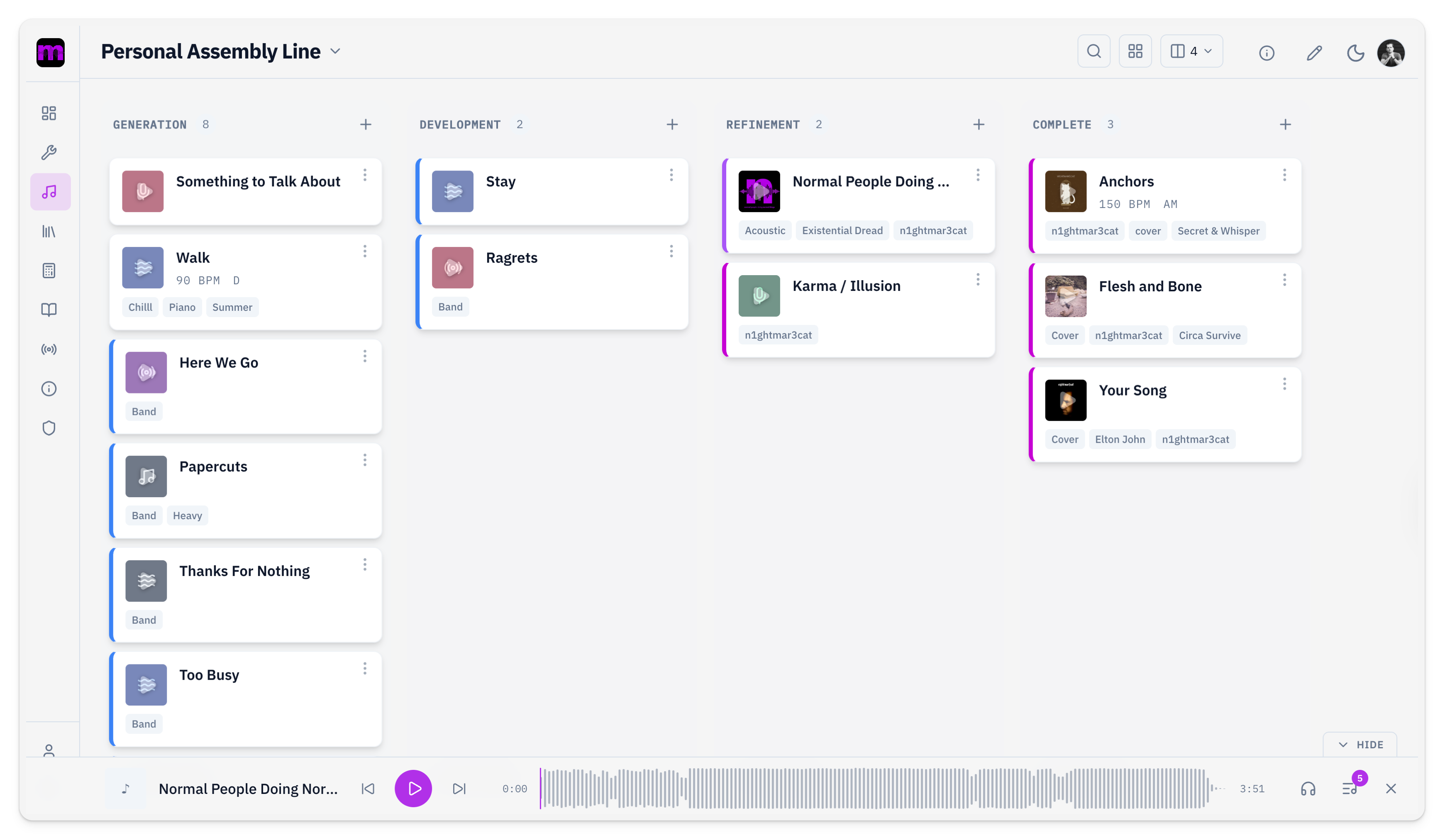
Among other useful creative utility tools, you’ll find a visual, Trello-style pipeline called ‘The Assembly Line’. I built it to mirror this three-stage framework, letting you visually organise your tracks as they progress from rough Generation demos, through the daily brick-laying of Development, and finally into high-grit Refinement and mastering. You can drag and drop your tracks between stages, upload different versions as the song develops, and see exactly where the bottlenecks in your progress are.
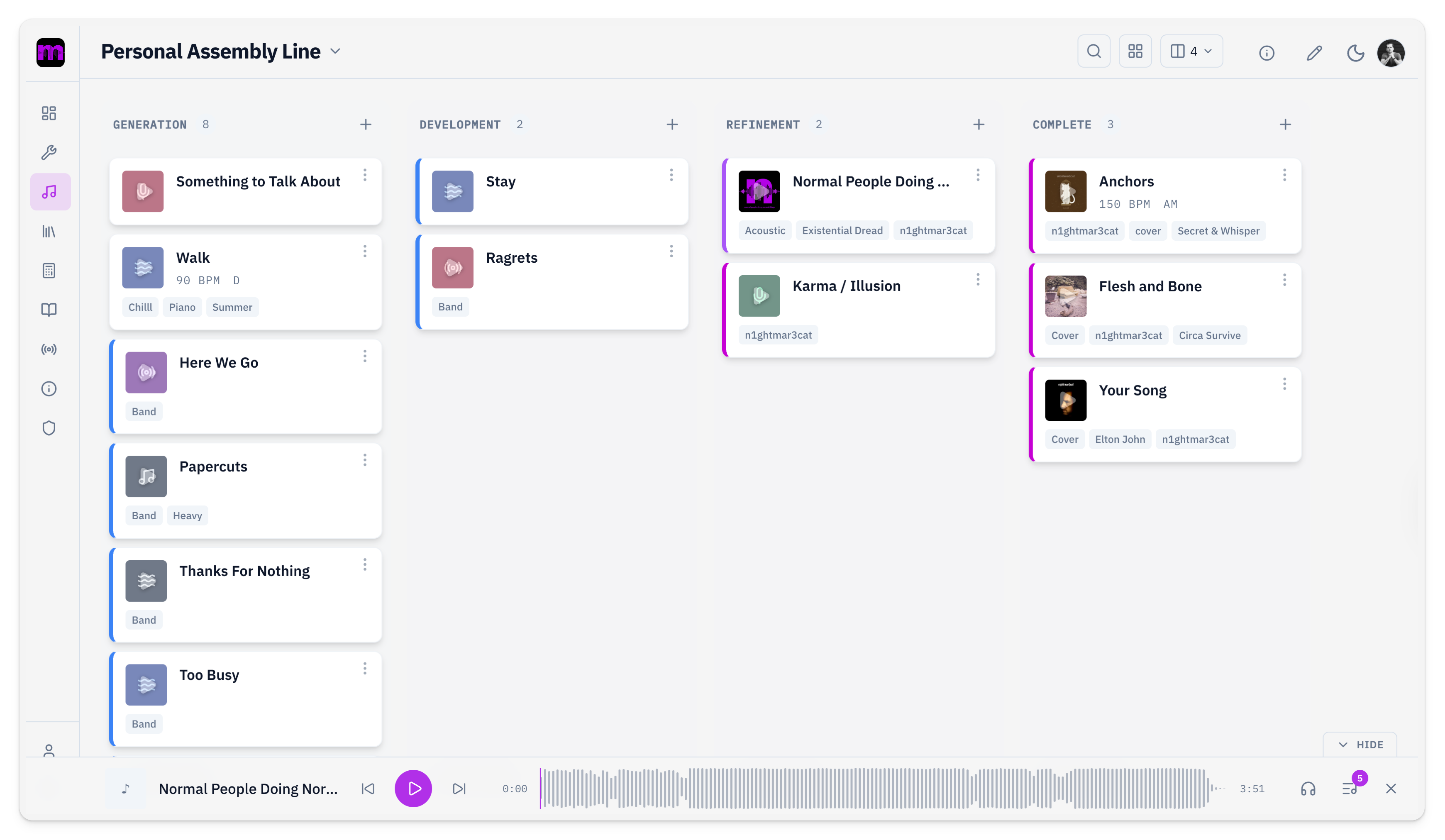
If you want to put this system to the test and see how it impacts your creative output, you can sign up for a free one-month trial over at musicfactory.nz.
Which of these three stages do you typically find yourself getting stuck in? Do you struggle more with getting ideas down or crossing the finish line? Let me know by leaving a comment 💬
ICYMI: My Latest Release
Copycat EP 01 is a collection of covers dedicated to artists who have influenced my musical identity. It was a gratifying creative challenge to transform the songs into something new with the sonic fingerprint of n1ghtmar3cat while retaining what made them special to me in the first place.


Love reading about other's creative process. Amazing how it's similar yet also different it can be from my own and from what I've seen other artists implement.
Great piece.